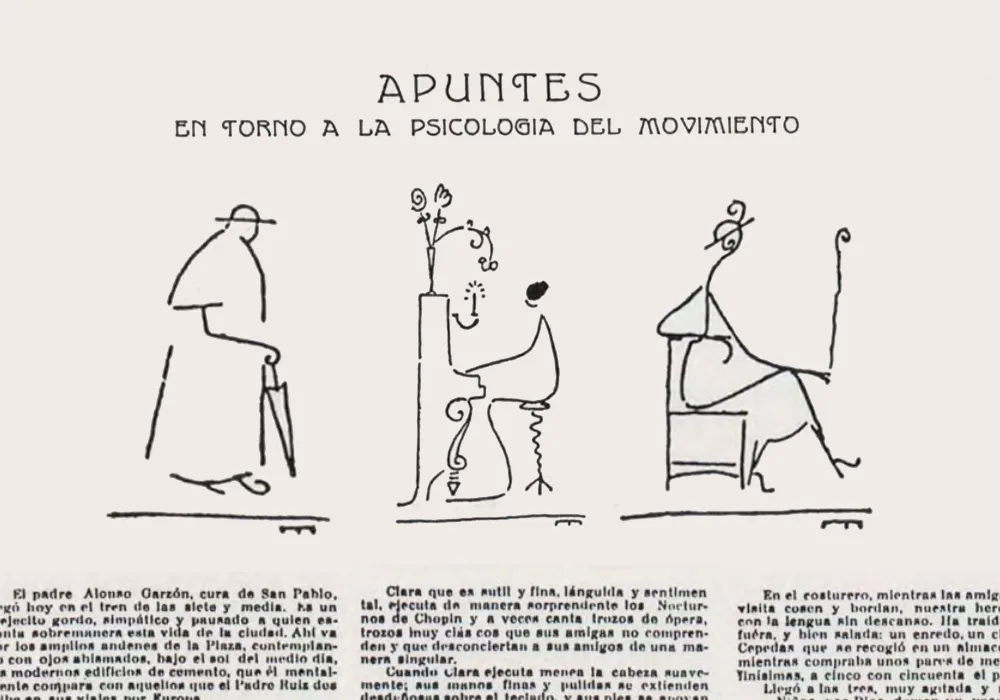
Concepción is not only the birthplace of notable figures (like brothers José María and Salvador Córdova) but also a cradle of creativity and art. We are talking about a true pioneer of graphic design and caricature in Colombia: José Félix Mejía Arango (also known artistically as Pepe Mexía). A unique idiosyncratic mix of Mondrian, Miró, and Picasso, whose work undoubtedly deserves far more recognition and honors than it has received so far.

We hope this is the first, not the last, attempt to revitalize and rescue the name of Colombia’s greatest avant-garde artist of the 20th century.
He was born on February 22, 1895, in Concepción, Antioquia, to Félix Mejía and Sara Arango. His father was from Yarumal and related to the poet Epifanio Mejía, while his maternal uncle Claudino Arango married Isabel Carrasquilla, sister of the writer Tomás Carrasquilla, with whom he developed a close friendship that greatly influenced his personality and artistic life.

His childhood was spent in several towns in northern Medellín where his father’s businesses operated. His father died in 1904, and soon after, he came under the guardianship of Don Claudino, who also lived in Medellín. There, he completed high school at Colegio de San José and studied civil engineering at the School of Mines.
He never pursued this profession, as his true passion was for literature, art, and architecture. Due to limited financial resources, he could not pursue formal studies in architecture, which did not yet have faculties in Colombia, and traveling abroad was not an option.
During this time, he began to show a preference for modern art forms, revealing a completely original artistic personality. On February 15, 1915, he founded the magazine Panida with a group of young writers and artists, which became the center for the group known as "Los Panidas." This group was highly influential in literature and culture of the time, thriving in the bohemian life associated with Don Tomás Carrasquilla, and centered in cafés like El Globo, El Blumen, and La Bastilla. The magazine’s illustrations were by Ricardo Rendón, while Pepe Mexía contributed several literary "sins" under the pseudonym Cornelio Rufo Pino, writing poems and lyrical prose, and collaborated with Tisaza under the name "Helena de Maia."
The first four issues of Panida were directed by León de Greiff, and Pepe Mexía handled the last six. The magazine ended in June 1915, but his illustrations continued to appear in publications such as Revista Colombia, Sábado, and newspapers El Espectador, El Bateo, El Correo Liberal, and Colombia. Here, his "Juncos" series—stylized representations of figures exploring psychology, daily life, and customs—introduced avant-garde movements to Colombia.