
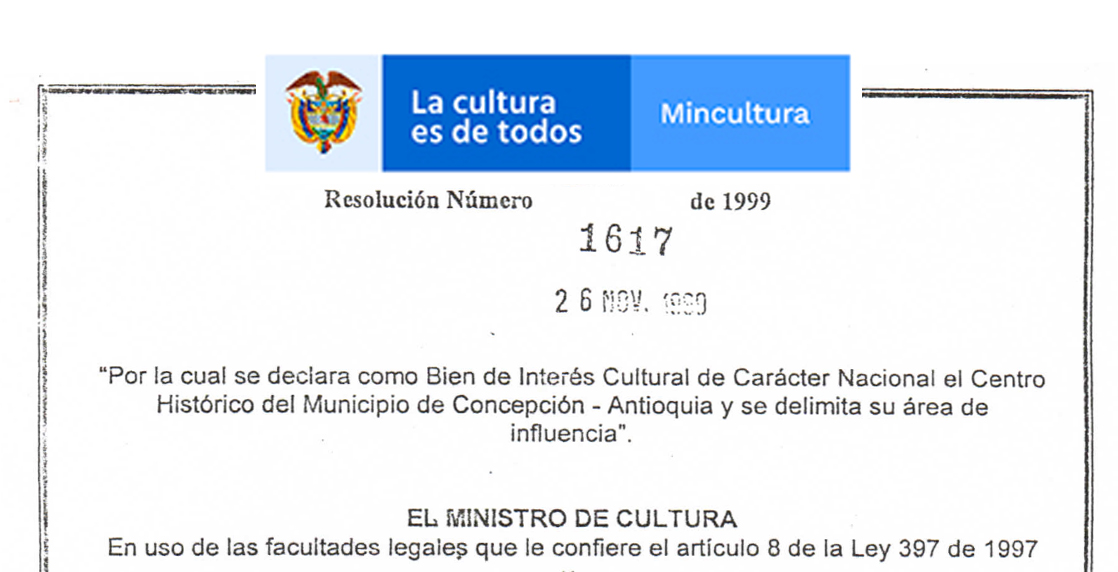
Concepción, Antioquia is a spectacularly beautiful and clean town deserving of well-earned distinctions due to its pristine cobblestone streets. However, for some time, contradictory information has circulated on tourism websites across Colombia (including many YouTubers, influencers, Wikipedia, and even the official mayor’s website) about whether this charming Antioquian town is officially recognized as Historic Heritage of the Nation. This discussion does not in any way intend to diminish the wonderful heritage of Concepción’s historic center; it only aims to clarify subtle differences in terminology. To save time for those who are not fond of reading, the correct definition is "Asset of Cultural Interest of National Character," as declared under Resolution 1617 on November 26, 1999, by then Minister of Culture José Luis Mejía Arango.
For those more inclined to read or passionate about definitions, keep reading. The topic is very interesting, and the aim of this article is to clarify differences and resolve doubts.
Let’s start by clarifying the definition of a Town with Architectural, Cultural, and Artistic Historic Heritage:
Law 1185 of 2008, Article 4, establishes that:
"The cultural heritage of the Nation consists of all tangible goods, intangible expressions, products, and representations of culture that express Colombian nationality, such as the Spanish language, the languages and dialects of Indigenous, Afro-Colombian, and Creole communities, traditions, ancestral knowledge, cultural landscapes, customs and habits, as well as tangible movable and immovable assets to which, among other things, special historical, artistic, scientific, aesthetic, or symbolic interest is attributed in areas such as plastic arts, architecture, urban planning, archaeology, linguistics, sound, music, audiovisual, film, testimonial, documentary, literary, bibliographic, museological, or anthropological domains."
Law 397 of 1997, defined as the General Law of Culture, establishes that:
"The National Council of Cultural Heritage outlines the procedure for declaring assets of cultural interest, the non-attachability, imprescriptibility, and inalienability of publicly owned assets of cultural interest, the special protection regime for assets of cultural interest, and adds an article regarding intangible cultural heritage."
The 17 towns recognized as Historic Heritage of the Nation in Colombia are (in strict alphabetical order):
The correct definition of this second classification is: "those assets and expressions to which individuals, groups, or institutions with legitimately attributed competencies, through a reasonable, reflective, transparent, and even public process, assign values or identity attributions."
According to this definition, Colombia has 1,083 assets of cultural interest of national character (updated as of December 6, 2022), of which 44 are towns, among which our beautiful Concepción, Antioquia deserves special mention.
There are three types of Assets of Cultural Interest: at departmental, district, or national levels. Concepción, Antioquia, due to its beauty and impact, was designated at the national level.
It is important to mention that Concepción is still in its early stages of tourism development. Consequently, the Ministry of Culture has been hesitant to elevate it to the category of Town with Architectural, Cultural, and Artistic Historic Heritage, mainly due to its limited tourism infrastructure (who hasn’t seen the town collapse a bridge during Holy Week because of the number of tourists waiting in line?). We trust that the progress of this incredible town will continue organically, sustainably, and beneficially for its population while respecting its magnificent natural environment.
Below is the signature of the Minister of Culture on Resolution 1617 of 1999: